

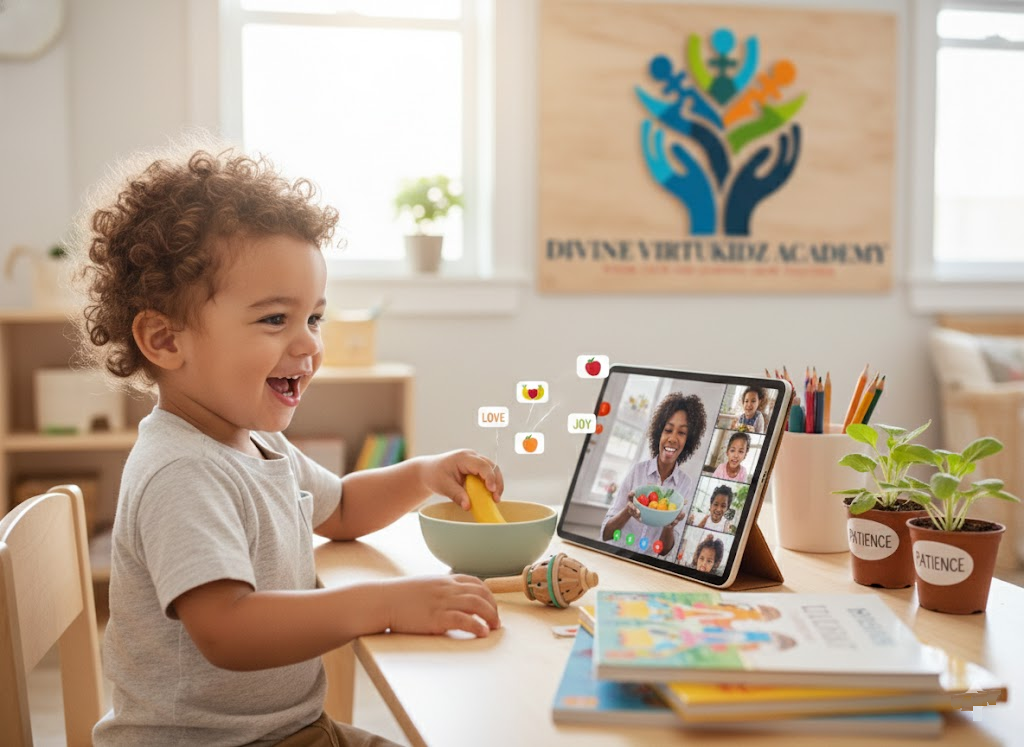
As Christian parents, one of our deepest desires is to see our children grow not just in stature, but in character. We want them to be kind, patient, and loving. In the Bible, Galatians 5:22-23 describes these traits as the “Fruit of the Spirit”: love, joy, peace, patience, kindness, goodness, faithfulness, gentleness, and self-control.
But let’s be honest—explaining the concept of “self-control” or “faithfulness” to a two-year-old can feel like trying to explain quantum physics! Toddlers are concrete thinkers; they learn through touching, tasting, moving, and playing.
At Divine VirtuKidz Academy, we believe that spiritual development should be woven into everyday fun. You don’t need a theology degree to teach these virtues; you just need a little creativity. Here are five fun, hands-on ways to bring the Fruit of the Spirit to life for your little one.
1. The “Fruit Salad” Taste Test
Since the Bible uses the metaphor of fruit, why not start there? This activity connects abstract virtues to concrete sensory experiences.
How to do it:
Create a “Spirit Salad” together. Assign a specific fruit to a specific virtue. For example, strawberries are red and sweet like Love. Bananas are soft like Gentleness. Oranges are bright like Joy.
As you chop and mix the fruit (using safe, toddler-friendly knives), talk about the traits. You might say, “Ooh, this banana is so soft; it reminds us to use gentle hands and gentle voices.” When you eat the salad, explain that just as the fruit nourishes our bodies, these virtues nourish our hearts.
2. The “Stop & Go” Game (Teaching Self-Control)
Self-control is perhaps the hardest fruit for a toddler to master. Their impulses are strong! Games that require physical regulation are the best way to build this “muscle.”
How to do it:
Play a game of “Red Light, Green Light” or “Freeze Dance.” Explain that Self-Control means being the boss of your own body. When the music stops, their body must stop, even if they want to keep wiggling.
When they successfully freeze, praise them specifically: “Wow! You wanted to keep dancing, but you used self-control to stop. That is a strong spirit!”
3. The Waiting Garden (Teaching Patience)
In a world of on-demand cartoons and instant snacks, Patience is a lost art. Gardening is the ultimate antidote because nature cannot be rushed.
How to do it:
Plant quick-growing seeds, like beans or sunflowers, in a clear cup with soil. Every morning, check the cup together.
Use this daily routine to talk about waiting. Say, “We can’t pull the sprout out; we have to wait. God is growing it in His time.” This provides a visual representation that good things are worth waiting for, laying the groundwork for spiritual patience.
4. The “Ouchie” Doll Clinic (Teaching Kindness and Gentleness)
Toddlers naturally mimic what they see. Role-playing is a powerful tool for practicing social interactions before they happen in real life.
How to do it:
Gather a few stuffed animals or dolls. Pretend one of them has a “boo-boo” or is feeling sad. Ask your child, “Mr. Bear is sad. How can we show him Kindness?”
Guide them to offer a hug, a pretend bandage, or a kind word. This practice helps them recognize the emotions of others and respond with empathy. It turns Kindness from a word into an action.
5. The Joyful Noise Parade
Joy is distinct from happiness; it is a deep gladness that comes from God. Music is one of the easiest ways to unlock this feeling in children.
How to do it:
Create homemade instruments using pots, pans, and wooden spoons, or rice in a sealed container (shakers). Put on some upbeat worship music and have a “Joy Parade” around the living room.
Teach them that Joy is something we can have even when things are tough. Afterward, talk about how praising God makes our hearts feel lighter.
Conclusion: Growing Little Hearts
Teaching the Fruit of the Spirit isn’t about demanding perfection from your toddler. It is about planting seeds. Some days will be filled with “Joy,” and other days will require a lot of “Patience” (mostly from you!).
At Divine VirtuKidz Academy, we partner with parents to reinforce these lessons every day. Through our faith-based online curriculum, we help nurture the whole child—mind, body, and spirit—ensuring that your child’s character grows right alongside their academic skills.
Start small, keep it fun, and watch your little one’s fruit grow!